
AI-Powered Technology at Sina Hospital Helps Treat More Than 10 Patients with Life-Threatening Aortic Aneurysms
A locally developed artificial intelligence (AI) software at Sina Hospital, affiliated with Tehran University of Medical Sciences (TUMS), is helping vascular surgeons make faster, more precise treatment decisions for patients with ruptured abdominal aortic aneurysms. According to the hospital’s vascular surgery team, the technology has supported the treatment of more than 10 patients over the past three months, most of whom were discharged in good condition.
The software analyzes medical imaging data in approximately 30 seconds, providing surgeons with critical measurements needed to plan endovascular procedures. Developed by Iranian specialists at a cost of approximately US$200, the locally adapted system offers an alternative to a comparable international software product reportedly priced at around US$15,000.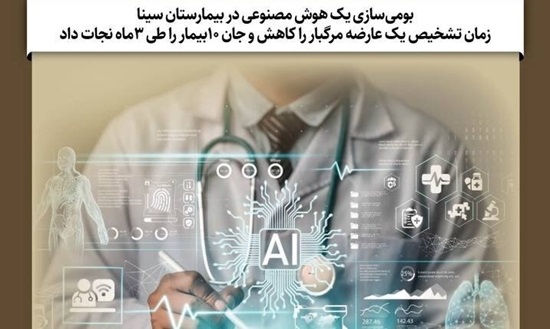
AI Supports Time-Critical Decisions in Vascular Surgery
Dr. Amin Shokri, a vascular surgeon at Sina Hospital, described the technology during an interview with Hamshahri on the sidelines of a ceremony marking the unveiling of the first commemorative stamp dedicated to artificial intelligence in healthcare at the hospital.
He explained that an abdominal aortic aneurysm occurs when the main artery supplying blood to the lower body becomes abnormally enlarged. If the aneurysm ruptures, it can cause severe internal bleeding and rapidly become life-threatening.
In selected patients, endovascular aneurysm repair offers an alternative to conventional open surgery. Rather than opening the abdomen, surgeons access the blood vessels through small incisions in the groin and insert a device to repair the affected section of the artery.
Accurate measurements of the vessel and precise determination of the device’s placement are essential to the procedure. The locally developed software helps surgeons obtain these measurements rapidly by analyzing CT angiography images and providing the information needed for treatment planning.
Dr. Shokri noted that the conventional process of reviewing vascular imaging, preparing radiology reports, and determining the appropriate device dimensions can take considerable time. The AI-based software can perform the required analysis in approximately 30 seconds, a particularly important advantage when treating patients with a ruptured aneurysm and severe blood loss.
He emphasized that AI is intended to support—not replace—clinical judgment. The final treatment decision remains the responsibility of the physician, while rapid access to accurate information can improve the precision and efficiency of that decision.
More Than 10 Patients Treated Over Three Months
According to Dr. Shokri, more than 10 patients with ruptured abdominal aortic aneurysms underwent endovascular treatment at Sina Hospital with the support of this technology during the preceding three months. All but one were discharged in good condition; the remaining patient died due to a cardiac complication.
He explained that patients with ruptured aneurysms often arrive at the hospital in critical condition. In particularly high-risk cases requiring open surgery, mortality can reach 80–90 percent, making minimally invasive approaches an important option for eligible patients.
Compared with open surgery, endovascular repair can reduce surgical trauma and shorten recovery time. Dr. Shokri noted that patients undergoing the minimally invasive procedure may be discharged after approximately two days if no complications occur, whereas hospitalization following open surgery typically lasts seven to 10 days.
A Coordinated Emergency Response Pathway
Alongside the software, Sina Hospital has introduced a dedicated emergency response code for patients with suspected ruptured abdominal aortic aneurysms. Once activated, the protocol alerts the relevant hospital teams and services, including the emergency department, imaging unit, operating room or angiography center, blood bank, and medical equipment team.
The goal is to minimize delays at every stage of care. The hospital aims to complete initial imaging and preparation within approximately 30 minutes and advance the treatment process within about three hours.
Dr. Shokri stressed that successful outcomes depend on coordinated teamwork among physicians, nurses, and hospital departments, as well as access to appropriate equipment. AI alone cannot save a patient; it must function as part of an integrated emergency care system.
The initiative is currently being implemented as a pilot program at Sina Hospital. The team hopes, with support from the Ministry of Health and Medical Education, to make both the software and the emergency response model available to other hospitals across the country. A mobile version of the software is also under development, potentially allowing physicians in different parts of Iran to review patients’ CT angiography images and make timely decisions.
Expanding AI Applications Across Clinical Care
The vascular surgery team at Sina Hospital is also exploring other applications of AI to support clinical decision-making.
One project focuses on carotid artery stenosis, a condition involving narrowing of the arteries that supply blood to the brain. Dr. Shokri explained that some patients with relatively moderate narrowing may still experience a stroke. Certain characteristics of arterial plaques, including structural and surface changes, may not be readily identifiable through conventional visual assessment. AI-assisted analysis could help identify high-risk patients more accurately and support decisions about their treatment.
Another project involves developing software to help prioritize patients awaiting kidney transplantation. The system analyzes donor and recipient information and identifies the five or 10 candidates with the highest priority according to established criteria. The software has been tested at Sina Hospital, and its results have been approved, according to Dr. Shokri. The team hopes to expand its use nationally.
He also referred to international advances in AI-assisted medical imaging, including applications in mammography, cardiac imaging, endoscopy, and colonoscopy. Such technologies can help clinicians identify suspicious findings during examinations and reduce the time required for initial assessment. However, he emphasized that AI-generated findings do not replace definitive diagnostic procedures or physicians’ evaluations.
Building the Data Infrastructure for AI in Healthcare
Dr. Shokri emphasized that wider adoption of AI in Iran’s healthcare system depends on establishing reliable digital health infrastructure. He identified fragmented patient records and the continued reliance on paper-based documentation as major barriers.
For example, when patients receive care at different hospitals, their medical histories may not be available in an integrated format to the next treating physician. A unified information system, using a consistent patient identifier, could enable authorized healthcare professionals to access relevant records, including previous treatments, laboratory results, medications, and clinical procedures.
He noted that AI systems depend on organized, complete, and reliable data. Integrating hospital information could therefore support not only diagnosis and treatment planning but also resource management and health policy development.
Engaging Iran’s Technology and Innovation Community
Dr. Shokri also highlighted the role of domestic knowledge-based companies and technology teams in advancing AI applications in medicine. He reported that more than 150 companies and technology groups had expressed interest in contributing to four AI-related projects presented by the hospital.
He called for stronger and more sustained financial and institutional support to help these teams develop their solutions. He also acknowledged the Ministry of Health’s support, particularly in providing computational infrastructure required for demanding AI applications, and expressed appreciation to Dr. Shahin Akhondzadeh, Deputy Minister of Health for Research and Technology.
AI as an Increasingly Essential Part of Modern Medicine
Concluding his remarks, Dr. Shokri stressed that AI is already transforming medical diagnosis and treatment and that healthcare systems must prepare the necessary infrastructure to benefit from its capabilities.
The experience at Sina Hospital, he noted, demonstrates how local expertise and collaboration with young specialists can adapt advanced technologies to domestic needs at a substantially lower cost. With continued support for researchers, technology companies, and digital health infrastructure, AI could help make healthcare services faster, more accurate, and more cost-effective.
Ultimately, the goal is to translate technological innovation into better clinical care and improved patient outcomes.
Your Comment :