
First OSIA Hearing Implant Surgery in Iran Successfully Performed at Amir Alam Hospital
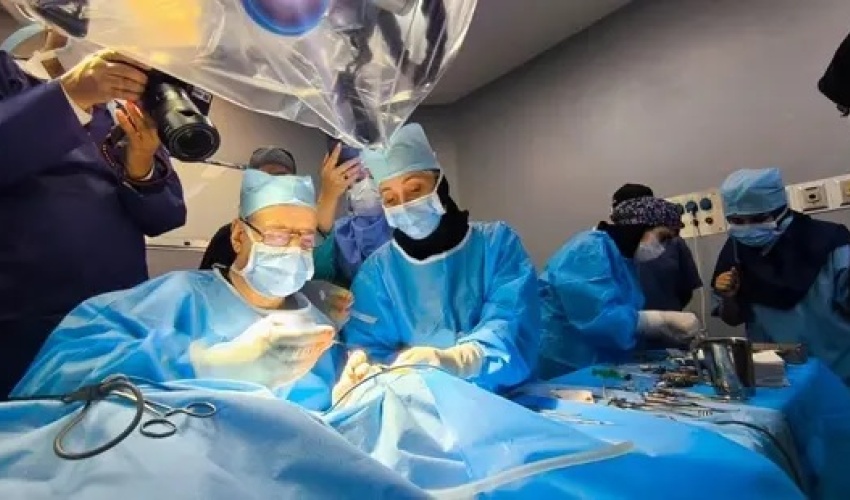
A team at Amir Alam Hospital, Tehran University of Medical Sciences (TUMS), has successfully performed Iran’s first implantation of an OSIA hearing device, introducing a new bone-conduction hearing technology for selected patients with complex hearing disorders.
The procedure was performed by Masoud Motesadi-Zarandi, MD, Professor of Otolaryngology (ENT), faculty member at Amir Alam Hospital, and Head of the Cochlear Implantation Department at Tehran University of Medical Sciences, in collaboration with a specialist surgical team.
The first patient to undergo the procedure was a 10-year-old child born with congenital absence of both external ears. Following detailed audiological and anatomical assessment, the medical team selected the OSIA system as an appropriate hearing rehabilitation option, and the implantation was successfully completed.
The procedure represents an important application of advanced hearing rehabilitation technology in a patient with complex anatomical conditions.
A new option for selected patients with hearing disorders
“Given the patient’s anatomical condition and the results of the specialist assessments, the OSIA hearing system was selected and the implantation was successfully performed,” said Dr. Motesadi-Zarandi.
The OSIA system uses bone-conduction technology, transmitting sound through vibrations in the skull directly to the inner ear. For appropriately selected patients, this approach can provide improved access to sound when conventional pathways of sound transmission are compromised.
According to Dr. Motesadi-Zarandi, the technology may be considered for selected patients with single-sided deafness, congenital absence or abnormalities of the outer or middle ear, certain patients following extensive ear tumour surgery, and some individuals with a history of chronic or longstanding ear infections.
It may also provide an alternative for some patients who require hearing aids but are unable to use conventional hearing aids effectively or choose not to use them, provided that their clinical and anatomical characteristics are suitable.
“OSIA is not appropriate for every patient,” Dr. Motesadi-Zarandi emphasised. “Careful assessment of hearing status, ear anatomy and other clinical factors is essential when determining whether a patient is an appropriate candidate.”
Expanding advanced hearing care at TUMS
The successful procedure marks a further step in the development of advanced hearing rehabilitation services at Amir Alam Hospital, Tehran University of Medical Sciences.
With its longstanding expertise in otolaryngology, cochlear implantation and the management of complex ear disorders, Amir Alam Hospital has continued to expand the use of advanced technologies and specialised treatment approaches in hearing care.
The introduction of OSIA implantation provides an additional hearing rehabilitation option for appropriately selected patients and highlights the clinical and academic capacity of TUMS teams to adopt and deliver emerging technologies in specialised healthcare.
The achievement also reflects TUMS’s broader commitment to advancing specialised clinical services through the integration of expertise, innovation and modern medical technologies*, with the aim of improving access to advanced care for patients with complex health needs.

Your Comment :